
InspectIQ / Vehicle condition workflow
Evidence.
Then judgment.
Follow one photograph from an advisory finding to a reviewer-confirmed record. The boundary between the two is the product.
Local product demonstration
Real application captures. Deterministic analysis. Scripted reviewer actions. No customer or accuracy claims.
Follow the evidenceStart with what
you can see.
One damaged door. One source photograph. A record that can follow both.
This image is a public-domain reference imported through InspectIQ, not a new mobile capture. Its metadata was stripped; the visible damage was not retouched.
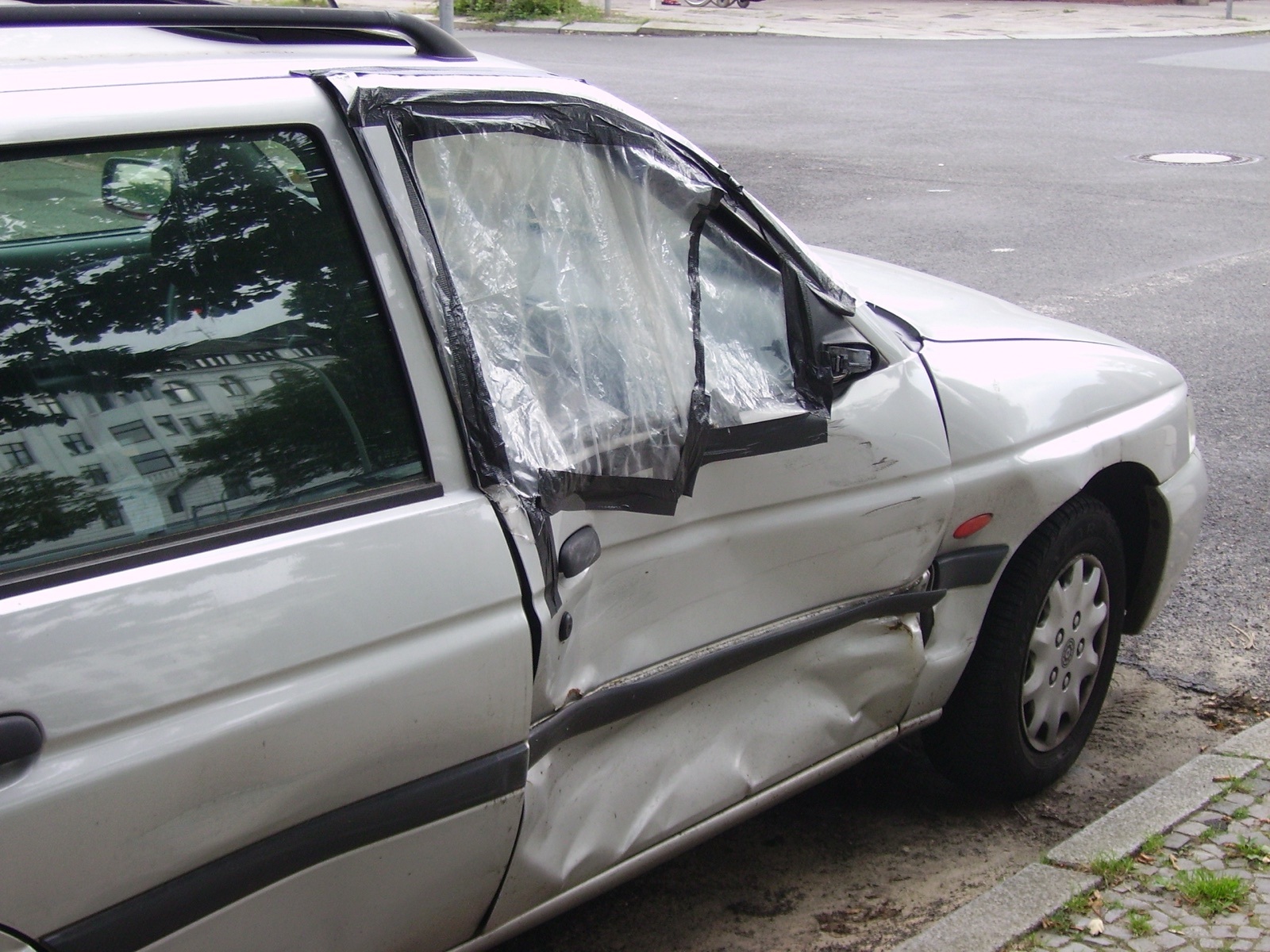 View the source photograph

Keep the source in viewThe workbench stores the photo with its capture source and evidence identity. Reference images stay distinguishable from newly captured vehicle photos.
Photo ID0e3b7efb-ab55-4be3-a5d9-b06ffd2ab2e5Inspect the recorded evidence ↗
Model suggestion ≠ vehicle fact
A finding,
not a verdict.
“Severe dent at front passenger door” enters a review queue. It does not become confirmed damage automatically.
In this recorded run, the real analysis pipeline uses deterministic-local-v2. The output is mocked to exercise the workflow. It is not proof that a vision model detected this dent.
The boundary
After analysis: no confirmed damage items. The proposed finding is pending, version 1, and explicitly requires human confirmation.
The confidence value and repair range in the fixture are illustrative. Neither is measured accuracy or a validated repair quote.
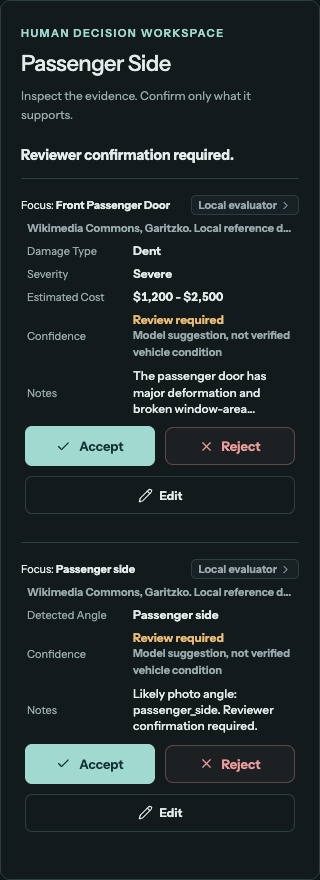
The buttons shown belong to a saved capture, not this tour.
Valid structure.
Unsettled truth.
Typed fields make the proposal reviewable. They cannot make it correct.
The recorded output passed the schema. Validation also enforced human review, even though the raw provider flag said it was not required.
Annotation from recorded JSON / Not a product screenshot
photo-analysis-v2- Location
- front passenger door
- Damage type
- dent
- Severity estimate
- severe Proposed, not verified
- Schema valid
- true Shape check only
humanReviewRequired: falsehumanReviewRequired: trueThe useful safeguard is the enforced review boundary, not the fixture’s confidence number. The photo, proposal and validation record remain linked for inspection.
The accountability handoff
The model proposes. The person decides.
The pixels did not change.
The status did.
A separate, version-checked reviewer action accepted the suggestion. Only then did the application create a photo-linked damage record and a suggestion.accepted audit event.
For this tour, that action was scripted using a local development profile. It demonstrates the human-review boundary, not a person inspecting a real vehicle.
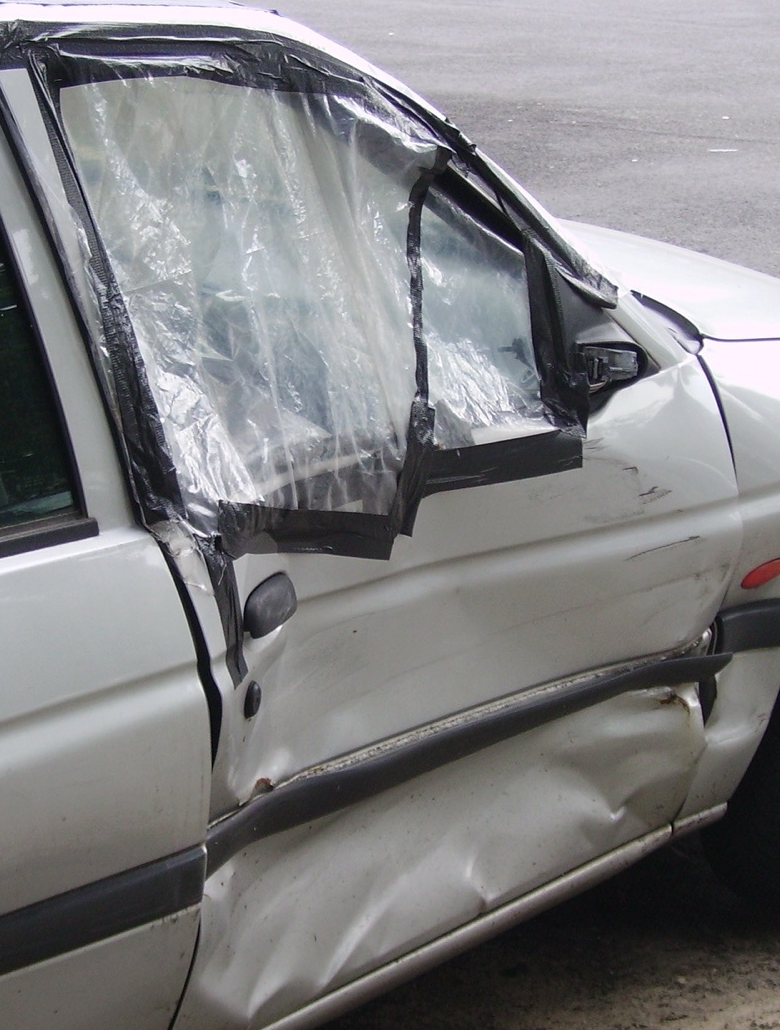
View the full source photograph ↗
Evidence-to-decision receipt
Recorded local states from a scripted reviewer action. These are not approval controls and do not write to InspectIQ.
Advisory / Not confirmed
- Suggestion
- Pending · version 1
- Photo-linked damage
- No confirmed record yet
- Human confirmation
- Required
Human-review gate / Recorded demo
- Suggestion
- Accepted · version 2
- Photo-linked damage
- Severe dent · front passenger door
- Confirmed by
- review-lead · scripted local demo
- Decision time

Same photo0e3b7efb-ab55-4be3-a5d9-b06ffd2ab2e5
Recorded eventsuggestion.acceptedLinks the suggestion to the new damage record.
Confirmation is one gate, not permission to publish. With only this photo, the application blocked grading. The report needs more evidence and a separate release decision.
The finding
keeps its source.
The same confirmed door finding appears in a versioned report draft, with the same photo identity.
This is an actual draft generated by the local application through its normal endpoints. No report approval or finalization was performed.
Synthetic context / Not a complete car inspection
Seven additional, explicitly labeled fixtures filled the workflow’s context slots. They are not photographs of this vehicle. The screenshot’s “Verified”, “None” missing and 4.1 reference grade reflect those fixture decisions, not physical-car verification, true coverage or condition accuracy.
- Report
- Version 1 · Draft
- Finalized
- No
- Buyer-ready
- No · Final report not released
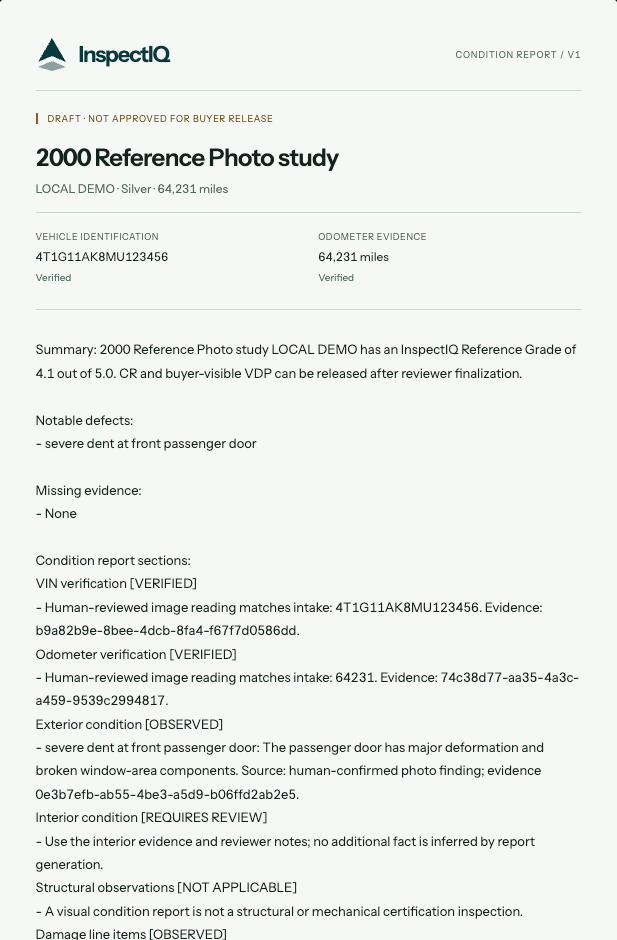
Source excerpt below is transcribed from this report.
“severe dent at front passenger door”
Implementation, without overclaiming
What this tour proves.
What it does not.
Observed locally
Reference import, advisory review, structured validation, version-checked acceptance, an attributed audit event and a source-linked draft. The operational workbench is unchanged.
Branch-only / Optional
Captured from inspection/recon operations, commit 62f6e93: 53 commits ahead of local main at capture, not merged. Expo mobile and AWS adapters exist in the branch but were not exercised here.
Not established / Still to validate
Real-model damage accuracy, physical-device capture, real-vehicle coverage, production security, customer adoption and commercial outcomes. Integration into an auction operator’s stack is a future validation path, not a customer claim.
One source. A visible review boundary. A record you can trace.
Back to portfolioRecorded evidence & IDs
Photo: Garitzko / Wikimedia Commons
Scrollcraft: MIT license
Recorded local demonstration · Marketing case study
Recorded 13 October 2026